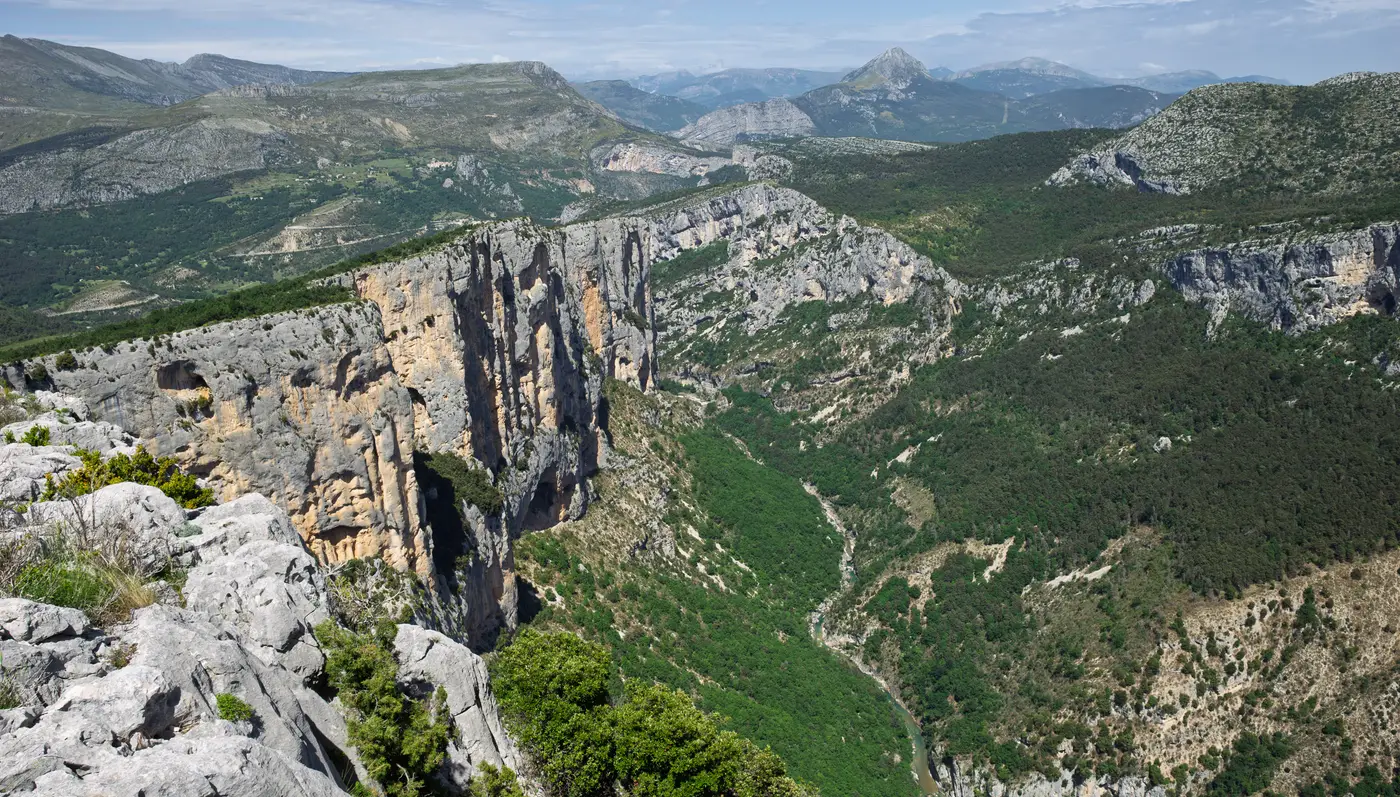
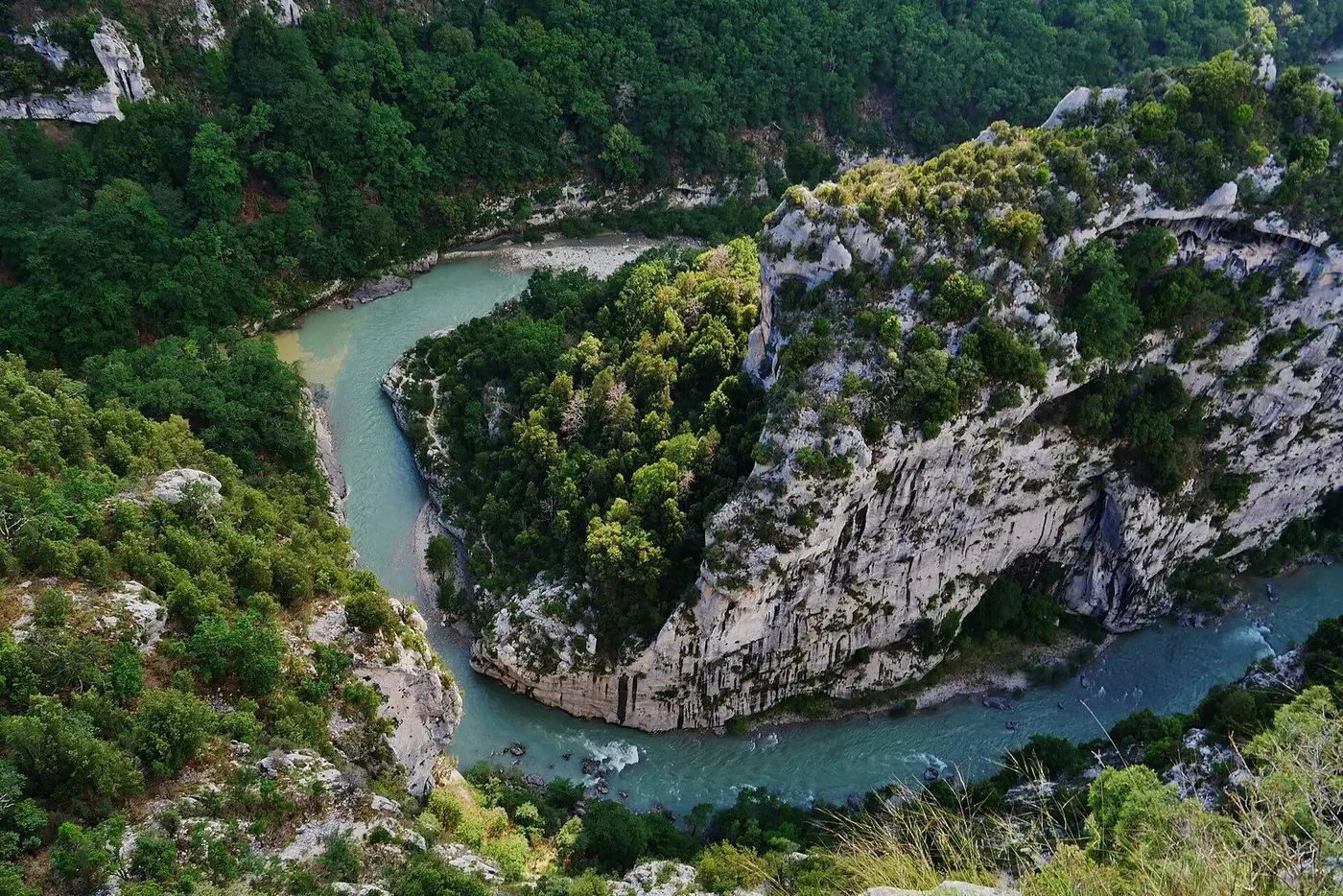
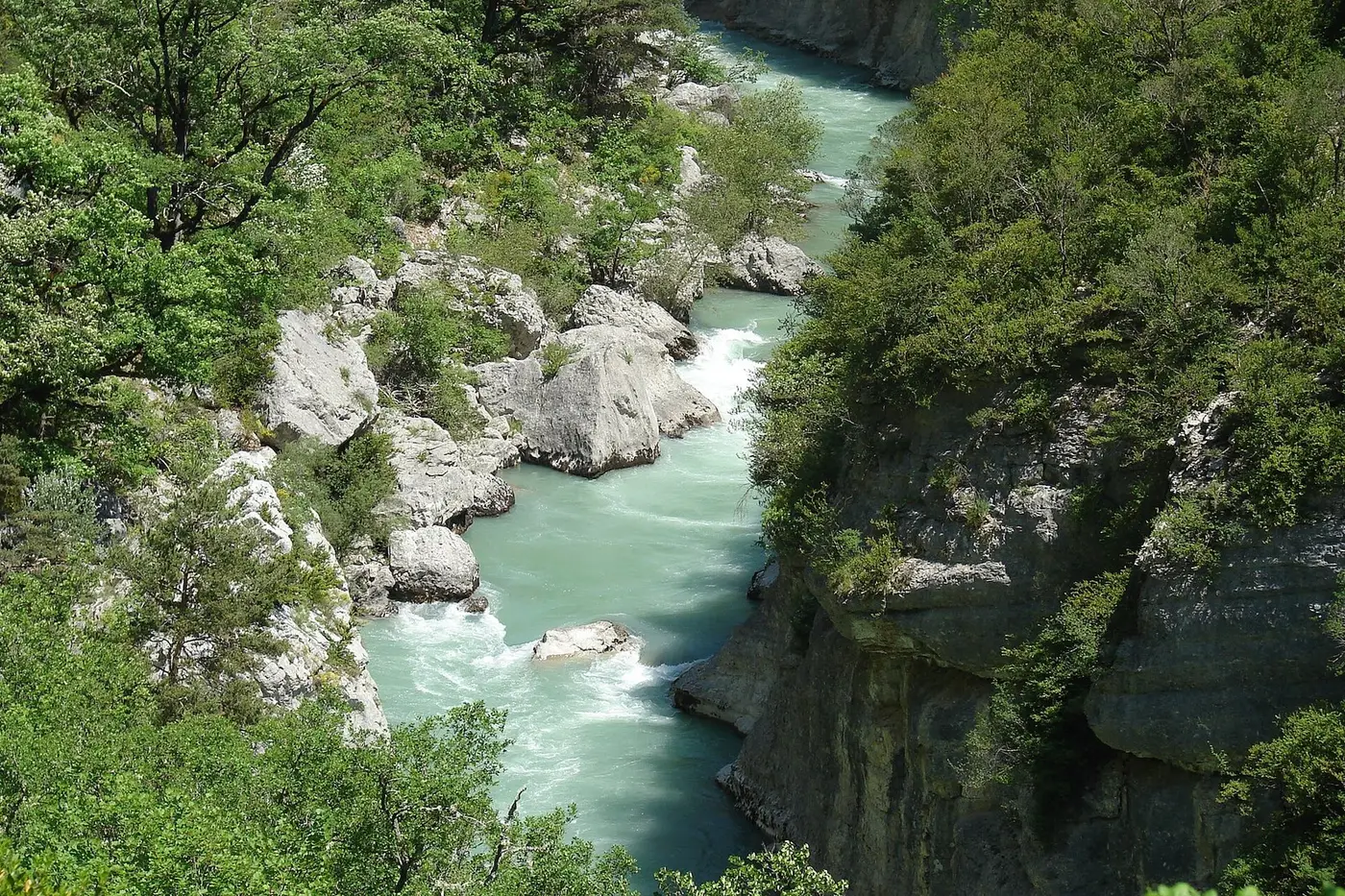
Carved by the Verdon through limestone, the Gorges du Verdon form a canyon about 700 m deep and about 25 km long, between Rougon and Lake Sainte-Croix. You can see them from above, by car, on two scenic roads, one per bank; from the bottom, on foot, on the Blanc-Martel trail; and from the water, by canoe from the Pont du Galetas, or by rafting or canyoning from Castellane.
Each line shows its source and the date it was last checked. Today’s alerts, the weather and the webcams are on “The Verdon live” page.
Blanc-Martel trail
The end of the trail is closed between the exit of the Couloir Samson and the Point Sublime, following a rockfall. The full hike remains possible via the official detour (RD23A then GR 49), with the same total duration. The Park’s shuttle runs until 1 November, Thursday to Monday.
Municipal order of Rougon dated 14 August 2026, according to navette.parcduverdon.fr; last checked on 17 October 2026.
Route des Crêtes (D23)
Its one-way central section closes in winter from the last Friday of November to the last Friday of March: this year, from Friday 27 November 2026 to Friday 26 March 2027 (dates calculated from this rule).
Département des Alpes-de-Haute-Provence (inforoute04.fr), winter closures table, consulted on 13 October 2026.
Corniche Sublime (D71)
Open: no closure between Aiguines and the Pont de l’Artuby. The Col d’Illoire trail is separate from the road: whether it is open has not been confirmed.
Info Route Var map of the Département du Var, last checked on 14 October 2026.
Five more conditions: car park, RD 952, Col d’Allos, bus
Point Sublime car park
Access is open and free of charge from 28 September 2026 to 29 April 2027.
Car park information sheet published by the tourist office, last checked on 9 October 2026.
RD 952 at Castellane
From Monday 26 October 2026 to Friday 22 January 2027, outside the built-up area: alternating one-way traffic controlled by traffic lights; on weekdays, from 8am to 5pm, closures of up to 10 minutes are possible.
Order of the Département no. 26-DRIT-1689-ATX dated 12 October 2026; last checked on 14 October 2026.
RD 952, Clue de Chasteuil
Between Castellane and the gorges, from Monday 2 November to Friday 11 December 2026: road closed Monday to Thursday from 8:15am to 12:30pm and from 2:00pm to 5:00pm, and on Fridays from 8:15am to 12:30pm, with two reopenings of 15 minutes, at 10:00am and 3:30pm.
Rougon town hall, published 2 October 2026; last checked on 14 October 2026.
Col d’Allos (Haut-Verdon)
Until Friday 30 October 2026, the pass cannot be crossed: on the Ubaye side, the road is closed day and night. On the Allos side, roadworks until 13 November: traffic is stopped Monday to Thursday from 8am to 5pm and on Fridays from 8am to 1pm.
Orders of the Département no. 26-DRIT-1618-ATX and 26-DRIT-1419-ATX, Allos town hall; last checked on 14 October 2026.
Without a car
Since 1 October 2026, no regular bus line goes into the heart of the gorges. Castellane is still served all year round by the 51 Nice–Digne line, two coaches a day in each direction.
Official open-data timetables of the Zou! network, checked on 6 October 2026.
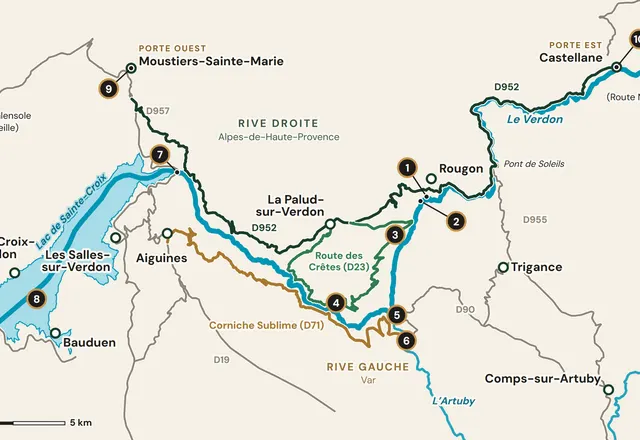
Two scenic roads, one per bank, two gateways and ten numbered places. The roads, rivers and lake follow their true course; the numbers match the list.
Right bank: D952
Route des Crêtes (D23)
Left bank: Corniche Sublime (D71)
Other roads
The Verdon, the Artuby, Lake Sainte-Croix
Place to see
The two banks only meet at the ends of the canyon: in the west at the Pont du Galetas (D957), in the east at the Pont de Soleils (D955). The D952, for its part, stays on the right bank.
Map data: OpenStreetMap, retrieved on 13 October 2026; places: Nominatim, 15 October 2026. North at the top, to scale.
The ten must-see places in the Gorges du Verdon
The numbers match those on the map. For each place: the time to allow, and the moment or the kind of visitor it suits.
The plunging view over the entrance of the canyon and the Couloir Samson, about a ten-minute walk from the car park. The Point Sublime →
Allow:
about 10 minutes’ walk from the car park to the viewpoint.
Ideal for:
a first view of the canyon, even if you are short of time.
2
Couloir Samson
Right bank · Rougon, below the Point Sublime
Where the Verdon squeezes into the upstream entrance of the Grand Canyon, at the foot of the Point Sublime: a listed site. It was from here that Édouard-Alfred Martel and Isidore Blanc set out, on 11 August 1905, on the first full crossing of the Grand Canyon. The Couloir Samson car park →
The end of the Blanc-Martel trail, between the exit of the Couloir Samson and the Point Sublime, is closed following a rockfall (municipal order of Rougon dated 14 August 2026): the official detour runs via the RD23A then the GR 49.
Allow:
a stop combined with the Point Sublime; the Couloir Samson car park, right next to it, is paid only in summer, from the start of the French school holidays to the end of August, with a price per entry.
Ideal for:
rounding off the view from the Point Sublime, during a short stop.
From the Chalet de la Maline to the Point Sublime, 15 km along the bottom of the gorges: 5 h 30 min of walking without breaks, with a shuttle for the return. The Blanc-Martel trail →
The end of the trail is closed between the exit of the Couloir Samson and the Point Sublime, following a rockfall (municipal order of Rougon dated 14 August 2026). The full hike remains possible via the official detour (RD23A then GR 49), with the same total duration.
Allow:
5 h 30 min of walking without breaks; the whole day, with the shuttle.
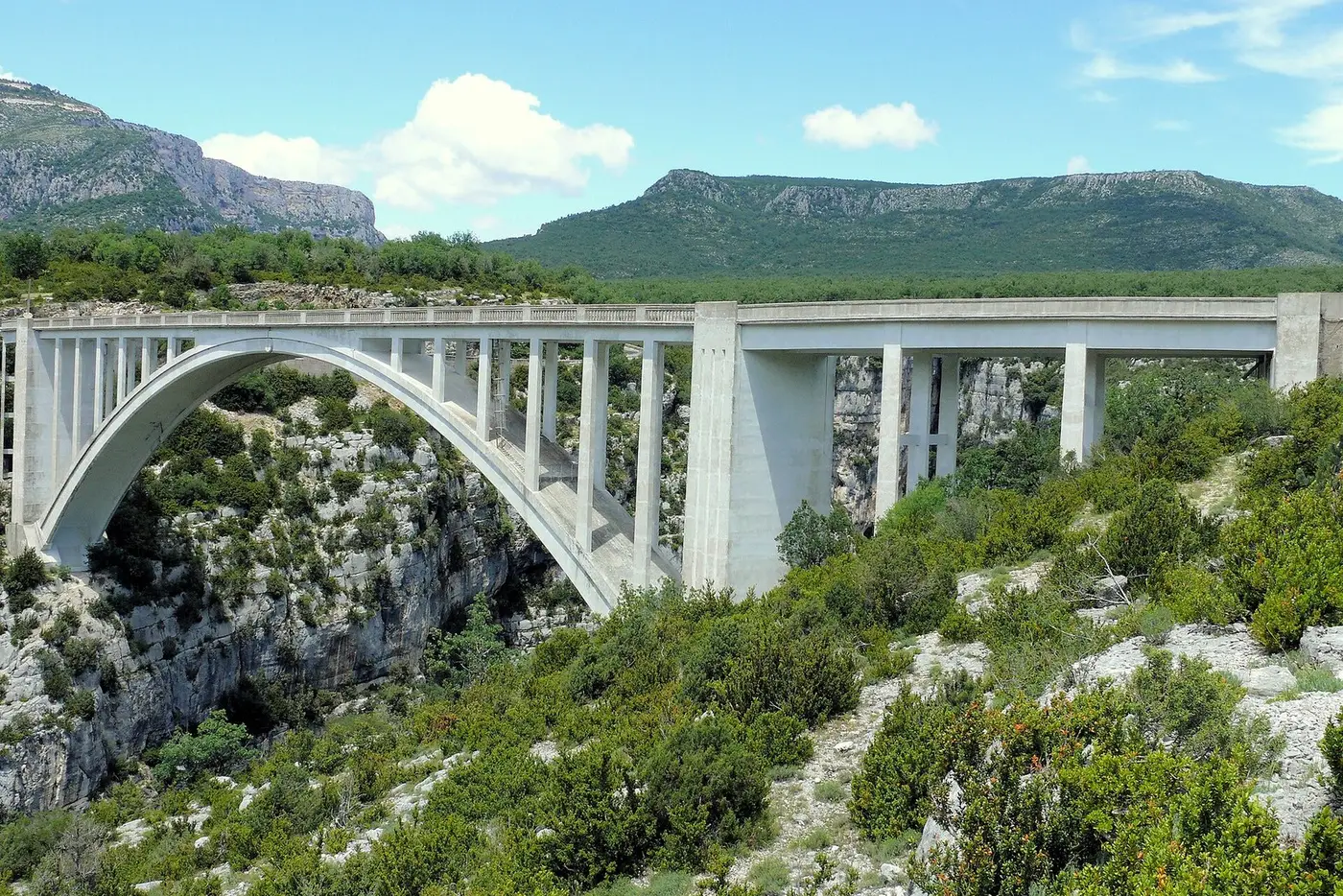
The arch that spans the Artuby gorge: about 137 m from the deck to the river according to the IGN, 182 m according to the bungee jumping operator. Bungee jumping →
Allow:
a stop along the Corniche Sublime; the whole day for a bungee jump.
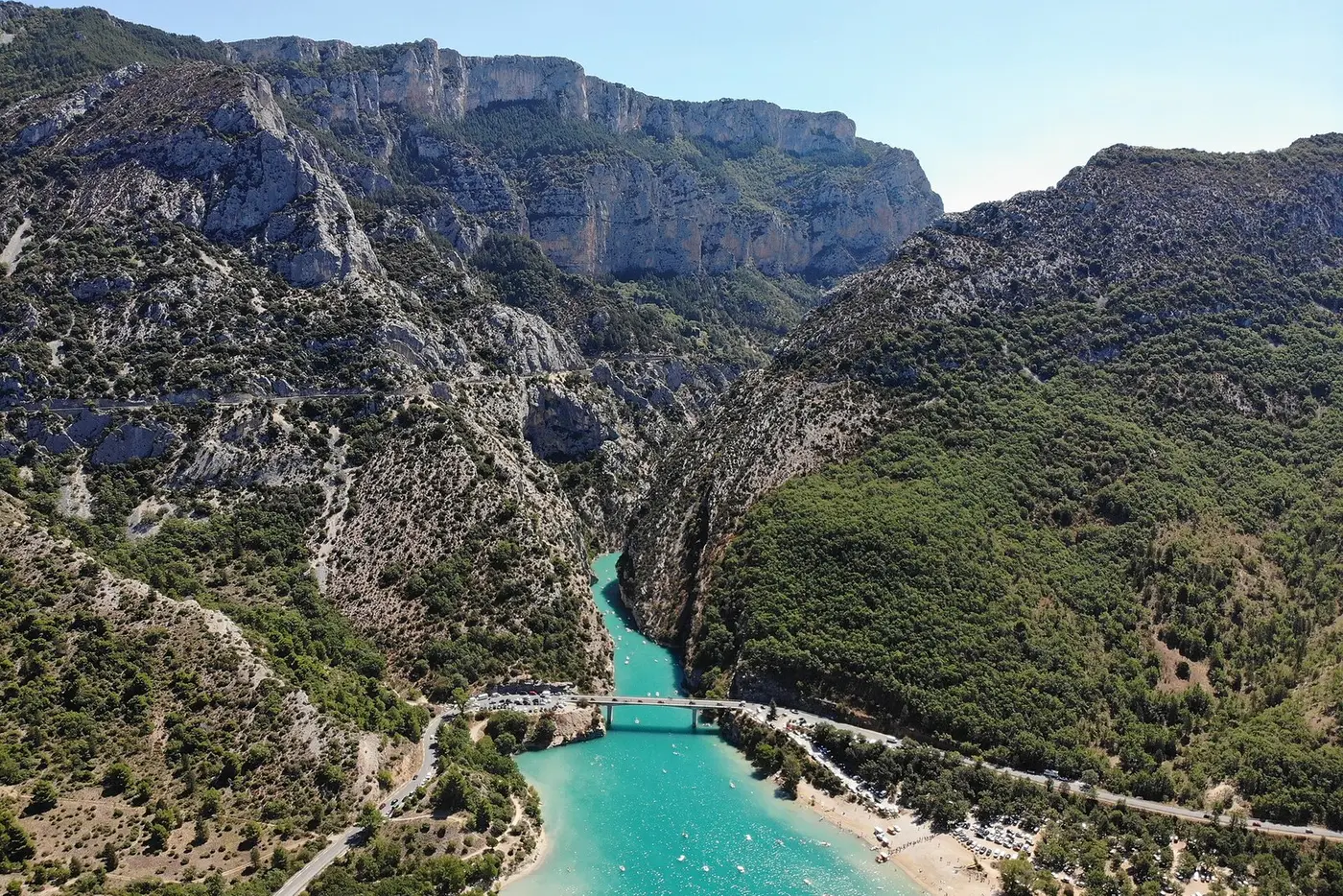
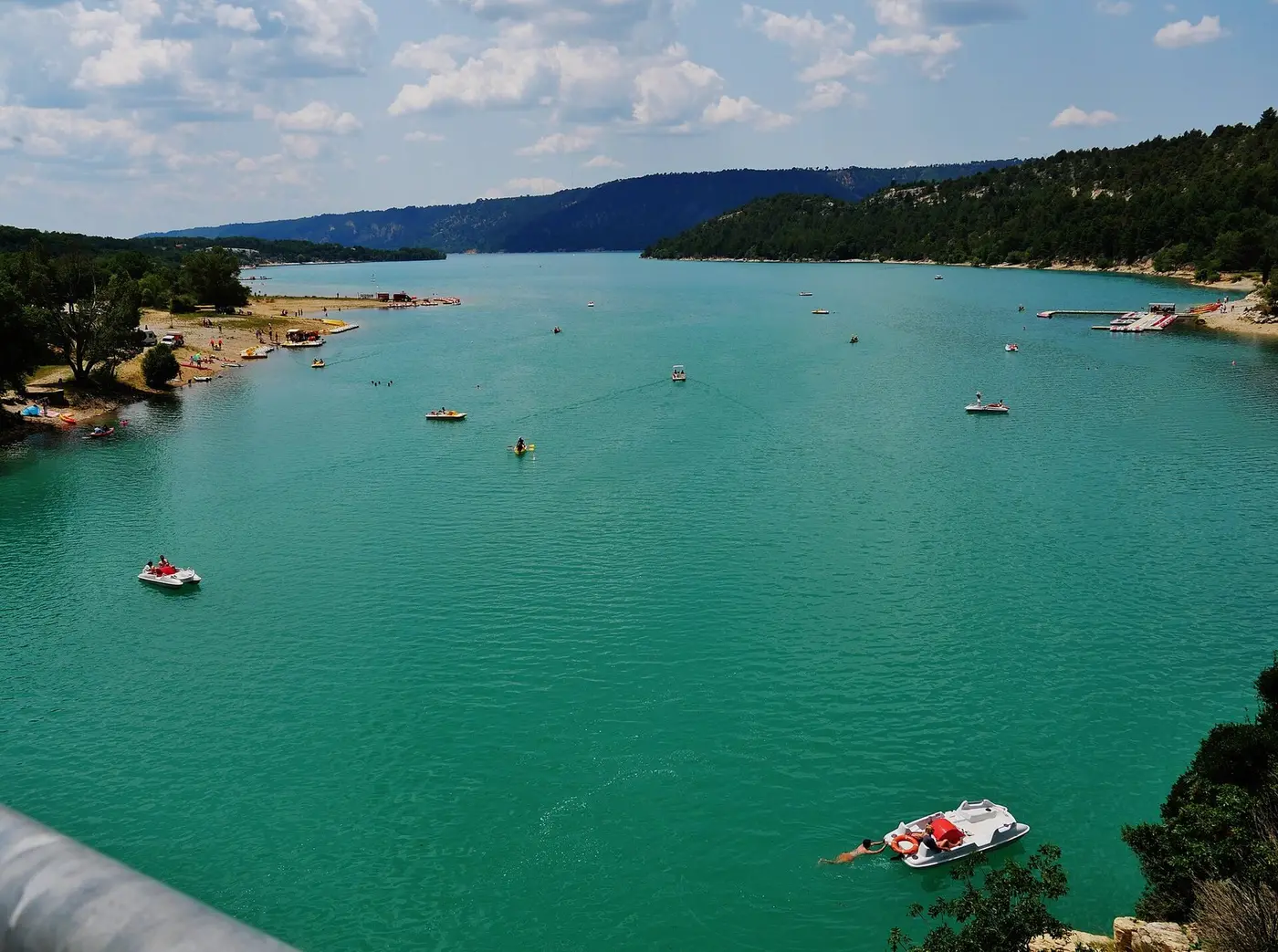
Where the canyon opens onto Lake Sainte-Croix. In the warmer months, you can rent a canoe, pedal boat or electric boat at the foot of the bridge to paddle up into the entrance of the canyon, for about 2 km. The Pont du Galetas →
Allow:
1 h 30 min to 2 h there and back by canoe, up to the buoys.
Ideal for:
paddling up into the entrance of the canyon as a family, in the warmer months.
Beaches all around the lake, several of them supervised in summer: it is the lake you swim in, never the river through the gorges (water releases by EDF). Canoes, pedal boats and electric boats can be rented at the Pont du Galetas. The beaches of Lake Sainte-Croix →
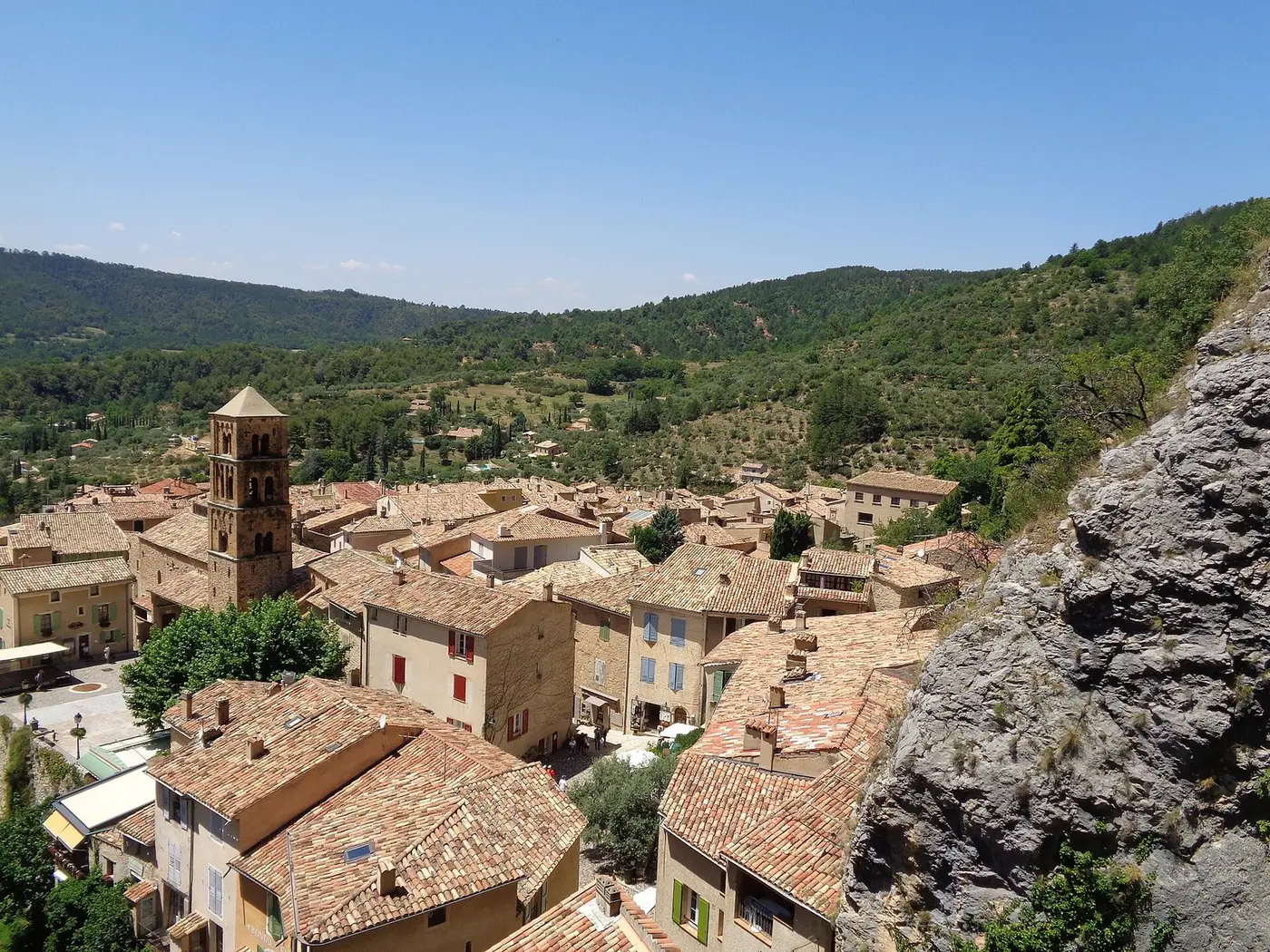
The faience village, set against two cliffs linked by a 135 m chain from which a star hangs. Above the rooftops, the Notre-Dame-de-Beauvoir chapel is reached by 262 steps. Moustiers-Sainte-Marie →
Allow:
15 to 20 minutes’ climb up to the chapel.
Ideal for:
the faience, the narrow streets and the view from the chapel.
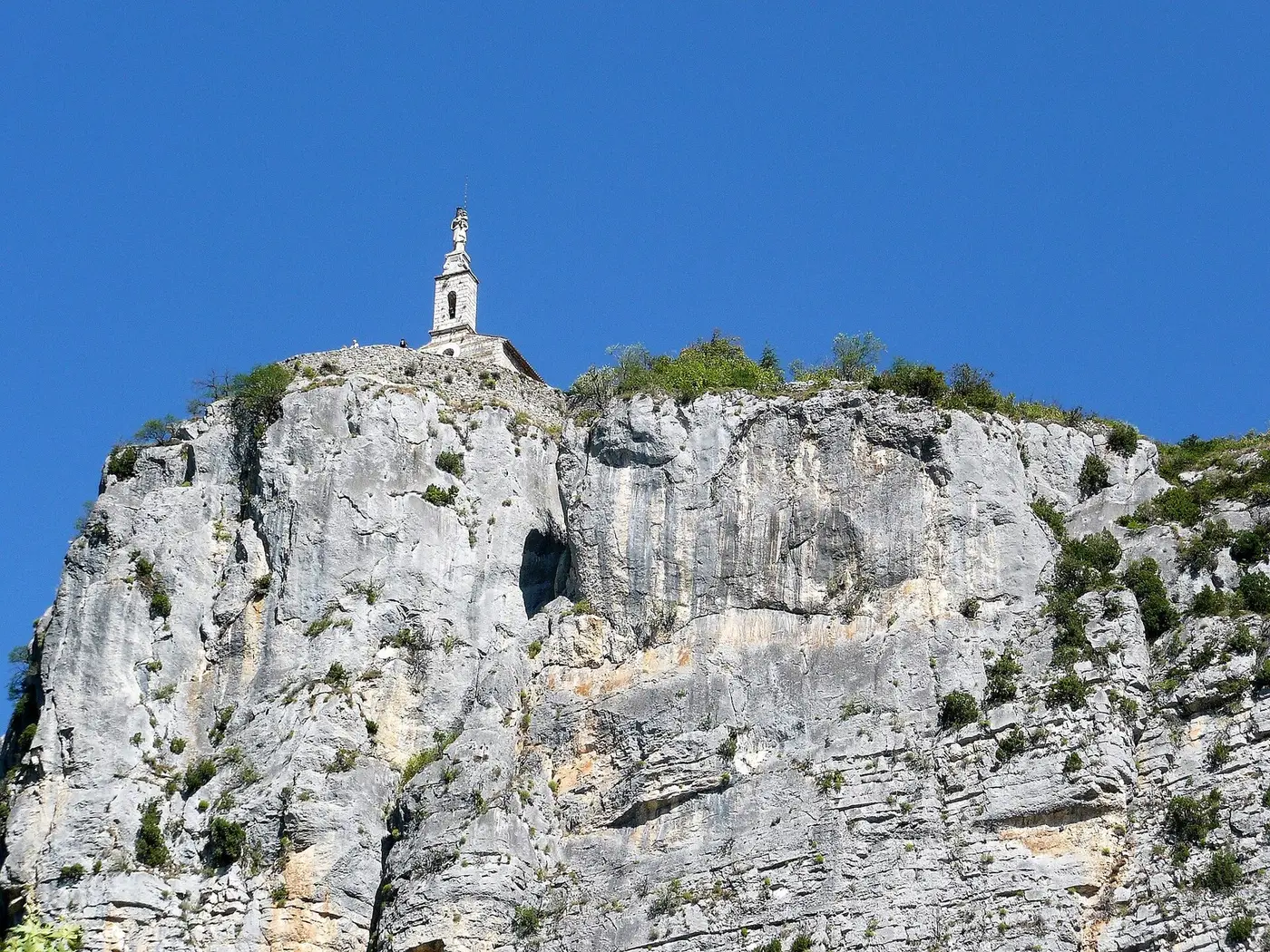
The east gateway of the canyon, the base for whitewater sports. Above the village, the Notre-Dame-du-Roc chapel crowns a rock that rises 184 m above it, a listed natural site since 1933. Castellane →
Allow:
about 30 minutes’ climb from the centre up to the chapel; 1 h to 1 h 30 min there and back.
Ideal for:
a stop as you arrive from Nice, then a rafting or canyoning run.
Two outings, not a loop: getting from one bank to the other means going around the canyon by one of its ends.
Right bank
North · Alpes-de-Haute-Provence
The one that strings together the most viewpoints.
Access
The D952, from Moustiers-Sainte-Marie to Castellane, via La Palud-sur-Verdon and the Point Sublime, at Rougon.
Road
The Route des Crêtes (D23), a loop starting from La Palud: 23 km according to the commune, 24 km according to Verdon Tourisme, 14 viewpoints according to the tourist office. One-way traffic is compulsory, clockwise, between the Pas de la Baou and the Chalet de la Maline.
Duration
From 1 h 30 min to 3 h by car, stops included, according to the Département’s portal.
To see
The Point Sublime (1), the Couloir Samson (2), the Route des Crêtes (3), the Blanc-Martel trail (4).
Fuel
One petrol station at La Palud-sur-Verdon.
Left bank
South · Var
The Corniche Sublime and its plunging views.
Access
Aiguines in the west; Trigance (D90) and Comps-sur-Artuby in the east.
Road
The Corniche Sublime (D71), about 21 km from the heart of Aiguines to the Pont de l’Artuby according to the tourist office. It reaches its highest point, around 1,200 m according to the IGN, as it skirts the upper edge of the Vaumale cirque.
Duration
About 1 h 30 min of driving without stops, according to the tourist office; half a day with breaks.
To see
The Col d’Illoire, the Falaise des Cavaliers, the Balcons de la Mescla (5), the Pont de l’Artuby (6).
Fuel
No petrol station at Aiguines or Trigance: fill up at Moustiers-Sainte-Marie or Aups when arriving from the west, at Comps-sur-Artuby from the east.
Allow at least two days. Since the two banks only meet at the ends, trying to see everything in one day means spending the day in the car.
1 day
One setting only
The canyon from above (the Point Sublime, then the Route des Crêtes) or from the water (the Pont du Galetas and Lake Sainte-Croix, in the warmer months).
2 days
The canyon and the lakes
One day on the right bank, one day at the lakes and in Moustiers-Sainte-Marie. The left bank has to wait for a third day.
3 days
Both banks without rushing
The heart of the canyon, then the lakes and Moustiers-Sainte-Marie, then the Corniche Sublime and Castellane: a loop that goes all the way around the gorges.
1 week
The whole Verdon
A long hike, a whitewater run from Castellane, the villages of the plateau, prehistory at Quinson.
Without a car. The Zou! 51 bus links Nice and its airport to Castellane, two coaches a day in each direction. Since 1 October 2026, no regular line goes into the heart of the gorges. The Verdon without a car →Indicative journey times, depending on traffic.
Parking, fuel and motorhomes
Parking
A small free car park at each viewpoint on the Route des Crêtes: they fill up quickly in summer, so arrive early. The Point Sublime car park is free from 28 September 2026 to 29 April 2027.
According to the tourist office, 4.30 m high and 12 m long at most on the canyon roads. The two tunnels on the Route des Crêtes have a clearance of only 3.60 m at the sides of the roadway.
The right place to stay is, first of all, the right area. The number of listings is the count in our directory on 19 October 2026.
La Palud-sur-Verdon
In the heart of the canyon, right bank
For hikers and early risers. Limited supply: book early.
17 listings
Castellane
The east gateway, services and whitewater
The widest choice in the territory, the most practical base for a first stay.
100 listings
The lakes area
West, swimming and families
Moustiers-Sainte-Marie, Sainte-Croix-du-Verdon, Les Salles-sur-Verdon, Bauduen.
55 listings
Aiguines
Left bank, hilltop village
For the Corniche Sublime and the Balcons de la Mescla. Restricted choice.
10 listings
Gréoux-les-Bains
Quiet, with thermal spas
Further from the gorges: a gentle stay, with day excursions.
19 listings
Featured accommodation
Listings marked “Ad” (LiveVerdon plan) or “Recommended by the publisher” (publisher’s client) are ranked ahead of the others. How listings are ranked
Camping La Ferme de CastellaneCampsite ★★★ · Castellane Checked against sources Recommended by the publisher: This business is recommended by LiveVerdon’s publisher. It is also a client of Livada for other services. Its listing appears ahead of free listings.
Entre Ciel et VerdonFurnished rental / gîte ★★★ · La Garde Checked against sources Recommended by the publisher: This business is recommended by LiveVerdon’s publisher. It is also a client of Livada for other services. Its listing appears ahead of free listings.
Hôtel du RocHotel-restaurant ★★ · Castellane Checked against sources Recommended by the publisher: This business is recommended by LiveVerdon’s publisher. It is also a client of Livada for other services. Its listing appears ahead of free listings.
From mid-May to June and from September to early October: good weather, open sites, moderate crowds and lower prices. July and August are ideal for swimming in the lakes, but very busy (car parks full by 10am at the popular sites). Swimming is forbidden in the river through the gorges, because of the risk of water releases by EDF. When to visit, season by season →
Frequently asked questions
What is there to do in the Gorges du Verdon?
See them from above, on the Route des Crêtes and the Corniche Sublime; from the bottom, on foot, on the Blanc-Martel trail; from the water, by canoe from the Pont du Galetas, or by rafting or canyoning from Castellane. You can also swim in the lakes, climb, or bungee jump from the Pont de l’Artuby. The full list is on our Activities page.
How long does it take to visit the Gorges du Verdon?
Allow at least two days: one day on the right bank of the canyon, another at the lakes and in Moustiers-Sainte-Marie. Three days let you cover both banks without rushing, because they only meet at the ends of the canyon.
What is the main town of the Gorges du Verdon?
Castellane is the main town of the Gorges du Verdon. As the east gateway of the canyon, it has the most shops, restaurants and accommodation, and it is the base for whitewater sports. In the west, the other gateway is Moustiers-Sainte-Marie, just above Lake Sainte-Croix.
What is the nearest town to the Gorges du Verdon?
Castellane, at the east gateway, and Moustiers-Sainte-Marie, at the west gateway, are the closest to the canyon. The nearest big city is Aix-en-Provence: 1 h 20 min to 1 h 30 min by road to Moustiers-Sainte-Marie, depending on traffic.
What is the most beautiful place in the Gorges du Verdon?
There is no objective ranking, but three places always come up: the Point Sublime, at Rougon, above the Couloir Samson; the Balcons de la Mescla, on the Corniche Sublime, where the Verdon meets the Artuby; the Pont du Galetas, where the river opens onto Lake Sainte-Croix. They are also very busy sites: arrive before 10am, or drive the Route des Crêtes to find some space again.
Where should you go to visit the Gorges du Verdon?
For a first visit, start with a viewpoint: the Point Sublime, at Rougon, on the right bank. Continue along the Route des Crêtes from La Palud-sur-Verdon, or head to the Pont du Galetas, in the west, to see the canyon from the water.
What is the best time to visit the Gorges du Verdon?
From mid-May to June and from September to early October: good weather, open sites, moderate crowds and lower prices. In winter, the central section of the Route des Crêtes is closed. The season-by-season detail is in our guide “When to visit”.
Can you visit the Gorges du Verdon without a car?
Partly. The Zou! 51 bus links Nice to Castellane all year round, but since 1 October 2026 no regular line goes into the heart of the gorges. Beyond Castellane, there is still the taxi, to be booked in advance, and the Park’s shuttle for the Blanc-Martel trail, until 1 November.
Are the Gorges du Verdon and the Grand Canyon of the Verdon the same thing?
In everyday use, yes. Strictly speaking, “Gorges du Verdon” is the name of the whole, and the “Grand Canyon of the Verdon” refers to its deepest section, between Rougon and Lake Sainte-Croix. Our page on the Grand Canyon of the Verdon tells its story.
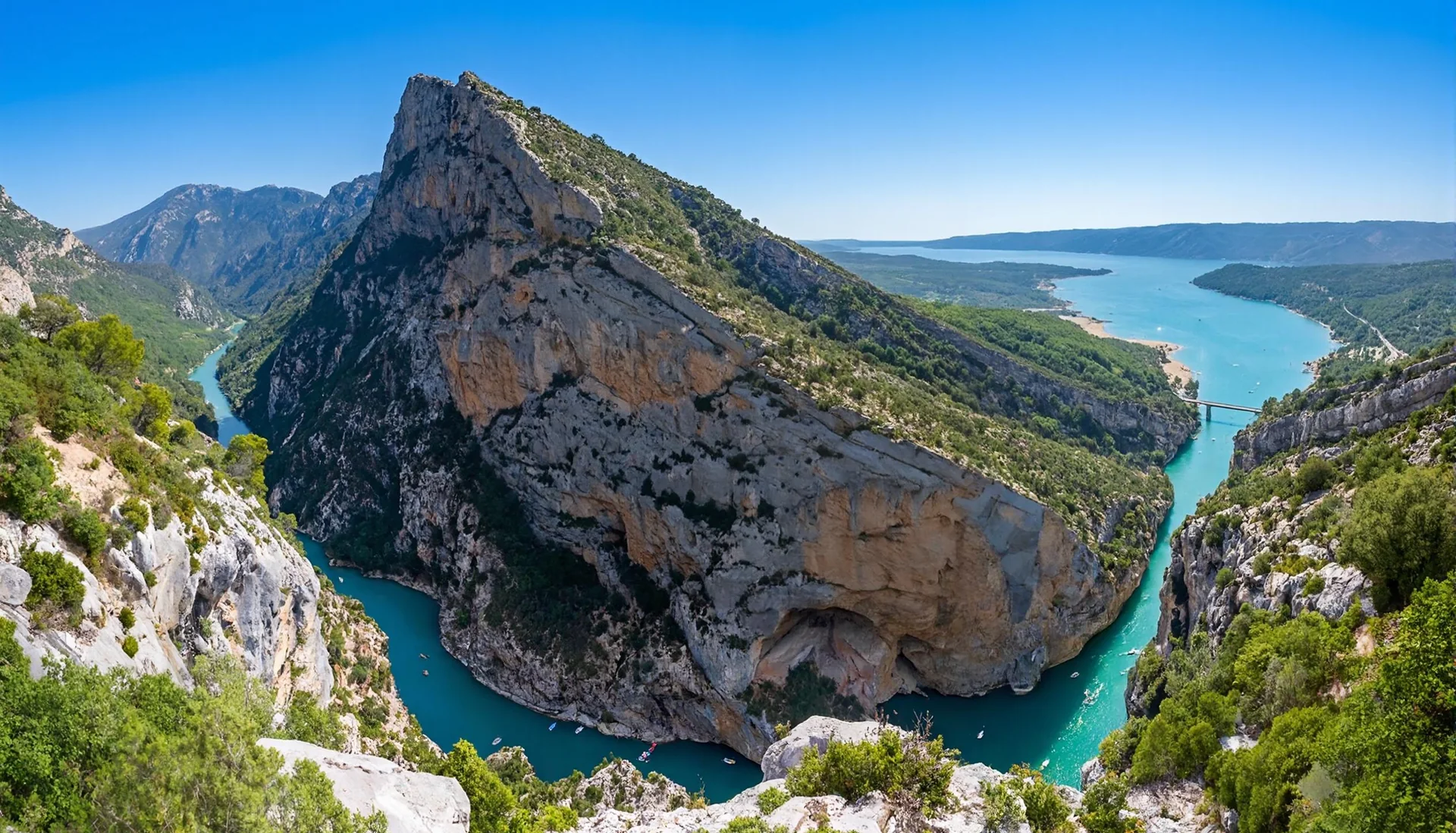

 A canyon about 700 m deepOver about 25 km, between Rougon and Lake Sainte-Croix
 Two banks, two moodsThe viewpoints on the right bank, the Corniche Sublime on the left bank
 Two gatewaysCastellane in the east, Moustiers-Sainte-Marie in the west
 From above, on foot or on the waterScenic roads, the Blanc-Martel trail, canoeing, whitewater
 Mid-May to June, September to early OctoberGood weather and moderate crowds; July and August for the lakes


 See the map
 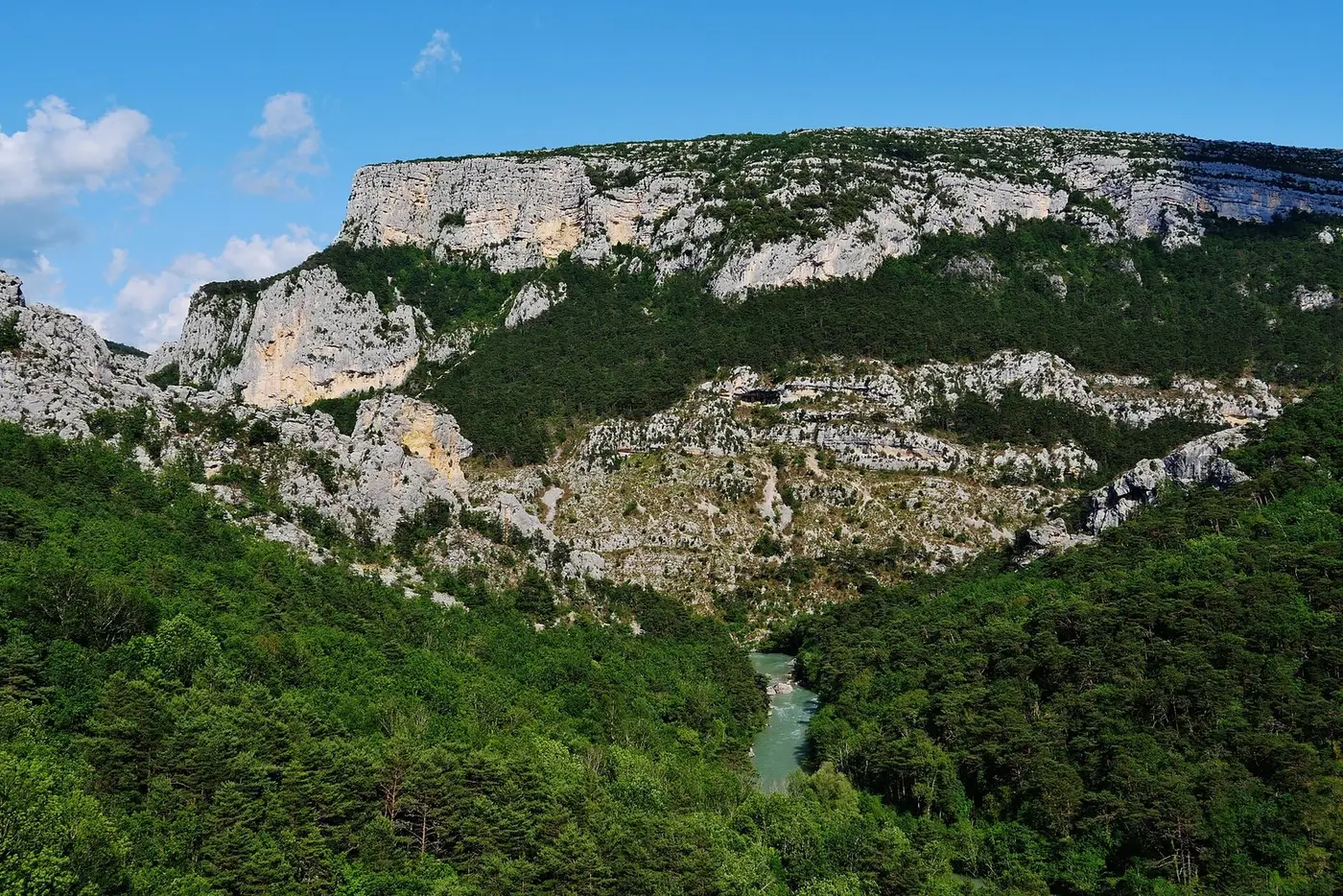 ViewpointsThe viewpoints over the canyon
  HikesTrails for every level
  Lake Sainte-CroixSwimming, beaches and activities
  Villages of the VerdonHilltop heritage
  ActivitiesWhitewater, canoeing, climbing…