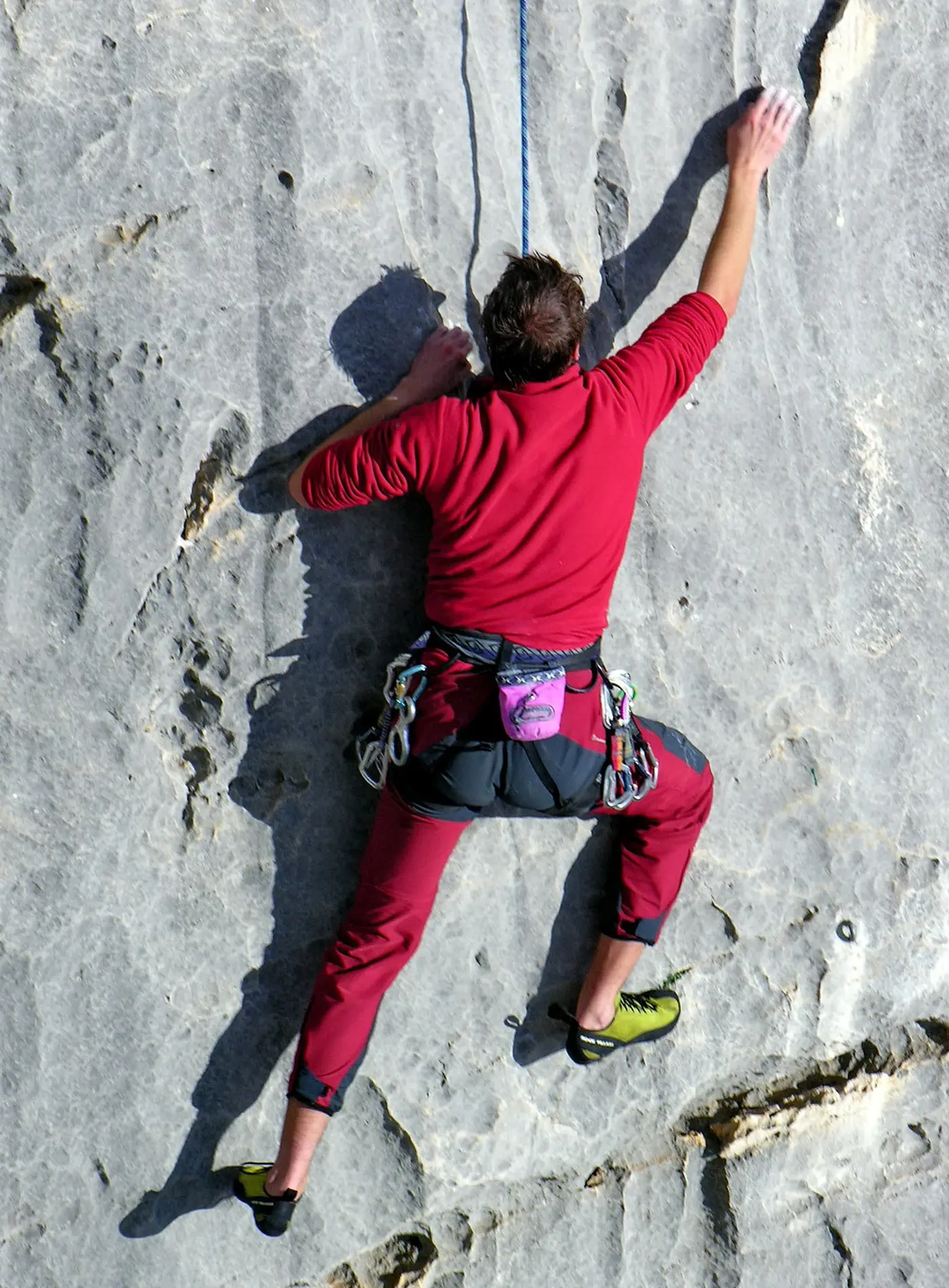
The Verdon is multi-pitch climbing country. On the Falaise de l’Escalès
and kilometres of limestone, more than 1,500 routes unfold, according to
Verdon Tourisme — often reached from the top, by rappel. It is
“one of the birthplaces of sport climbing”, according to the FFCAM (the French
federation of alpine and mountain clubs); people climb here from first-timers to the elite.
1,500+routesaccording to Verdon Tourisme · 300+ on l’Escalès
up to 350 mhighmulti-pitch routes
3b → 8con l’Escalèsfrom beginner to elite
1968first multi-pitch routeLa Demande
The Verdon’s signature: access from the top
Here, you don’t always climb up from the bottom. Many multi-pitch routes are reached by
rappelling down from the viewpoints along the Route des Crêtes — anywhere from a few
minutes to nearly an hour of rappelling — before climbing back up the wall. A distinctive
feature of the Verdon, which multiplies the famous “sense of exposure”.
The main sectors
La Falaise de l’Escalès
La Palud-sur-Verdon · right bank
The historic heart of climbing in the Verdon: up to 350 m of perfect grey limestone, more than 300 routes from 3b to 8c, edge-crimp slabs, small columns and water-drop pockets. Multi-pitch climbing at its finest, facing the void.
The top-access sectors
Single-pitch & beginners
From the viewpoints along the Route des Crêtes, a host of single-pitch sectors: Belvédère de la Carelle (ideal for beginners), Dent d’Aire, Jardin des Écureuils, Golem, École buissonnière, Félines, Chasteuil. Climb on lead or top-rope, panorama included.
The left bank
Aiguines · Var
The south bank has its own cliffs too, around Aiguines: Falaise des Cavaliers (multi-pitch routes and a viewpoint over the Corniche Sublime), Falaise du Baou.
Legendary routes
La Demande6a obligatory
The founding route of l’Escalès — around 290 m of elevation gain over 11 pitches, opened on 28-29 October 1968 by Joël Coqueugniot and François Guillot. Re-equipped in 2022.
Pichenibule7b+ (or 6c/A0)
A cult route, an emblem of the golden age of free climbing.
Surveiller et Punir7a+
A much-photographed multi-pitch route — it was here that Patrick Edlinger was once struck by lightning.
Fenrirsector 6a → 7c+
A sector popularised by Edlinger (Rêve de Fer, Alerte au Gaz, L’Ange en Décomposition).
Les Spécialistes8b+ / 8c
The reference route for the very highest level, near Rougon — proposed by Edlinger, freed by J.-B. Tribout.
DNA9c (proposed)
The La Ramirole sector — the hardest route ever opened in France, and one of the five 9c routes in the world. Climbed by Sébastien Bouin on 29 April 2022 after more than 250 attempts; repeated for the first time on 10 October 2026 by the Austrian Jakob Schubert, the first repeat of a 9c-graded route.
Easy multi-pitch routes to start on
Between single-pitch introductions (Belvédère de la Carelle, École buissonnière) and the
legendary routes above, there are real multi-pitch routes — several pitches, a real
big-wall atmosphere — within reach of a lead climber who is comfortable up to 5c/6a:
Adieu Zidane6a max (5 pitches)
Pont du Galetas sector, opened in 2002 by Bruno Clément — with a view over the pedalos and canoes heading up the gorge. 5 pitches (5b+, 6a, 5c, 5c+, 6a), slabs with little commitment, no approach walk. Descent in 3 rappels, or in one go on a 100 m static rope.
L’Arête de la Patte de Chèvre4c to 5b+ (7 pitches)
Col des Félines sector, ≈150 m — slab, corner and arête, at a consistent grade. Approach of ≈40-50 min from the Félines car park (Col de l’Âne road); descent on foot (≈45 min), no rappel needed.
Chlorochose5b/5c (7 pitches)
The easiest route in the Dalles Grises sector, on l’Escalès — reached by 4 rappels from the Jardin des Écureuils. Very consistent and generously equipped: a good introduction to the big-wall atmosphere without the difficulty of the sector.
DNA (9c): the hardest route in France, opened in the Verdon
On 29 April 2022, at the La Ramirole sector, Sébastien Bouin redpointed “DNA” after
more than 250 attempts and proposed the grade 9c — at the time only the
world’s second route of this level ever announced, after Adam Ondra’s “Silence”
(Norway, 2017). DNA remains the hardest route ever opened in France. On 10 October
2026, the Austrian Jakob Schubert made its first repeat, the first of a 9c-graded
route anywhere in the world; the four other routes of this level had not been
repeated at that date.
Getting started & guided climbs
The Verdon is best discovered with an experienced guide. The Belvédère de la Carelle
and École buissonnière sectors are suited to beginners, and around fifteen guide
offices run introductory sessions, multi-pitch outings and via cordata trips. Find them
in our directory.
The Verdon has no classic via ferrata (Alps-style continuous cable). What is practised
here under that name are via cordata: adventure routes on natural rock, secured by a
rope lifeline. Three levels, from beginner to expert:
Beginner / discoveryTrou du Renard
A rappel, a ~45 m zip line, a pendulum swing: the perfect introduction. From age 12, ~3 hours.
SportyMainmorte
A dry canyon, multiple rappels, a zip line, a suspended garden. From age 14, ~5 hours.
ExpertCataractes / Couloir Samson
180 m of cumulative rappelling, passages 150 m up, a 60 m pendulum rappel, through the former structures of an abandoned dam. From age 16, ~6 hours.
One of the birthplaces of sport climbing, according to the FFCAM
1905Martel explores the canyon and describes the boxwood harvesters hanging from the walls — Verdon’s verticality, ahead of its time.
1968The pioneers (Coqueugniot, Guillot, Cordier, Gorgeon) open La Demande: the Verdon’s first multi-pitch route is born.
The 1980sPatrick Edlinger, “le Blond”, brings free climbing in the Verdon to the general public.
1984Jean-Paul Janssen’s film “Opéra Vertical”, shot in the gorge, cements the Verdon’s legend.
Vultures: routes to avoid from January to August
The Verdon is home to a protected population of griffon vultures. Every year, the LPO
lists the sensitive routes to avoid during nesting season (from January to August; from June to August for some, depending on how close the nests are): a single passage can cause a brood to
fail. Check the up-to-date list before you climb. Safety & regulations →
When to climb & which topo guides to use
The best conditions are in spring (April–June) and autumn (September–October);
early and in the shade in summer, in the sun in winter. For topo guides, the reference is
“Escalade au Verdon” (OmegaRoc) — more than 450 multi-pitch routes and around thirty
single-pitch sectors — complemented by ClimbingAway, theCrag and UKClimbing. Plan your trip
with When to visit and Getting there.
Frequently asked questions
Is there a via ferrata in the Gorges du Verdon?
No: the Grand Canyon of the Verdon has no classic via ferrata (continuous cable, metal rungs and monkey bridges like those found in the Alps). What operators offer under that name are via cordata — adventure routes equipped with a rope lifeline, on natural rock (Trou du Renard, Mainmorte, Couloir Samson). It’s a choice made to preserve the cliffs.
Can beginners start climbing in the Verdon?
Yes. Despite its reputation as committing terrain, the Verdon has beginner-friendly sectors accessed from the top — notably the Belvédère de la Carelle and the École buissonnière — and around fifteen guide offices run introductory sessions, multi-pitch outings and via cordata trips. For a first real multi-pitch route (several pitches), Adieu Zidane, l’Arête de la Patte de Chèvre or Chlorochose remain within reach of a climber who is comfortable up to 5c/6a. Starting out with a professional is strongly recommended.
Why do you access Verdon routes by rappel?
It’s the Verdon’s distinctive feature: many multi-pitch routes are reached from the top, rappelling down from the viewpoints along the Route des Crêtes (anywhere from a few minutes to nearly an hour of rappelling). This cuts down the approach walk… but means you have to be able to climb back up the route you just descended. A guaranteed sense of exposure.
What is the best time of year to climb in the Verdon?
Spring (April–June) and autumn (September–October) offer the best conditions. In summer, climb early and in the shade (intense heat, possible afternoon storms); in winter, stick to sunny sectors. Note: the LPO asks climbers to avoid, from January to August, the routes close to vulture nests; the list is drawn up every year and relayed by the Verdon regional park.
Where should you stay to climb in the Verdon?
La Palud-sur-Verdon is the climbers’ base camp: most of the sites are within ten minutes, and the village combines accommodation, shops, a guide office and a climbing shop. Find accommodation options in our directory.
What is the hardest climbing route in the Verdon and in France?
“DNA”, at the La Ramirole sector, graded 9c. Sébastien Bouin redpointed it on 29 April 2022 after more than 250 attempts and proposed this extreme grade — at the time the world’s second announced 9c route, after Adam Ondra’s “Silence” in Norway. No harder route has been opened in France since. On 10 October 2026, the Austrian Jakob Schubert made its first repeat: it is the first time a 9c-graded route has been repeated anywhere in the world.
Check for yourself
The external sources this page relies on, one click away. We would rather you be able to contradict us than ask you to take our word for it.
Scheme run by the Park and the LPO setting a framework for climbing during raptor nesting. ⚠️ It is a GOOD PRACTICE CHARTER, not a prefectural order — we never present it as a regulatory obligation.
Bird protection association in charge of monitoring the vultures in the Verdon, which initiated the climbing restriction periods for the nesting season.
Article from the Austrian media outlet Der Standard. The Tyrolean Jakob Schubert, aged 35, redpointed DNA in the Gorges du Verdon. He is the first climber to have repeated a 9c route and the first to have climbed two of them. Five climbers in the world have climbed this grade.