Verdon spleenwort
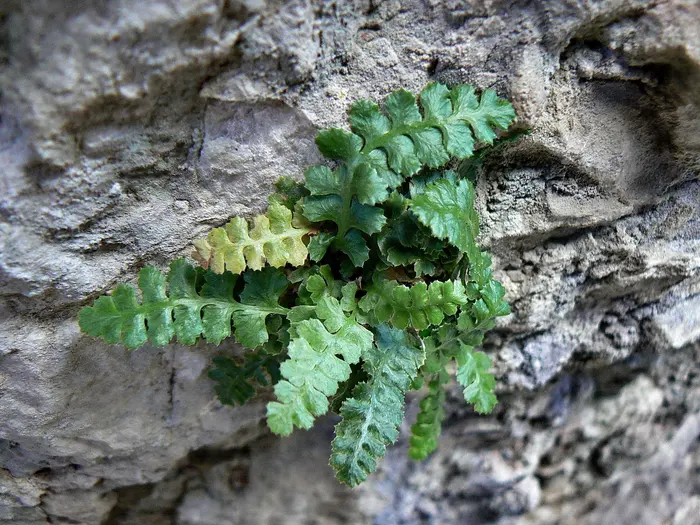
Asplenium jahandieziiA small fern that grows nowhere else on Earth except in the cracks of the Verdon’s cliffs. Discovered in 1911, protected at national level, it is the botanical jewel of the canyon.
Flora · The wild Verdon
Where the Alps meet the Mediterranean, the Verdon brings together on a small territory a third of all the flora of France. From lavender fields to cliffs where a fern found nowhere else on Earth clings on, here is the plant richness of the canyon — explained simply, and verified.
The secret of this richness can be summed up in one sentence: the Verdon is a crossroads. The Mediterranean climate, warm and dry, meets the alpine influence there, cooler and mountainous. Add to this a mosaic of habitats — limestone cliffs, scree, forests, dry grassland, riverbanks. The result: the Parc du Verdon shelters some 2,200 plant species, around a third of all French flora, on less than 2,000 km². Some live only in the Verdon or in the Southern Alps alone.
A small fern that grows nowhere else on Earth except in the cracks of the Verdon’s cliffs. Discovered in 1911, protected at national level, it is the botanical jewel of the canyon.
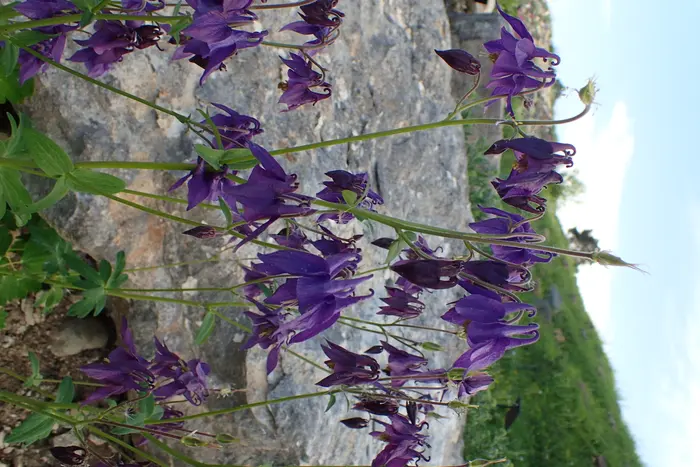
A deep-blue, rare columbine that flowers in cool scree — notably in the Gorges de Saint-Pierre. Protected at national and European level.
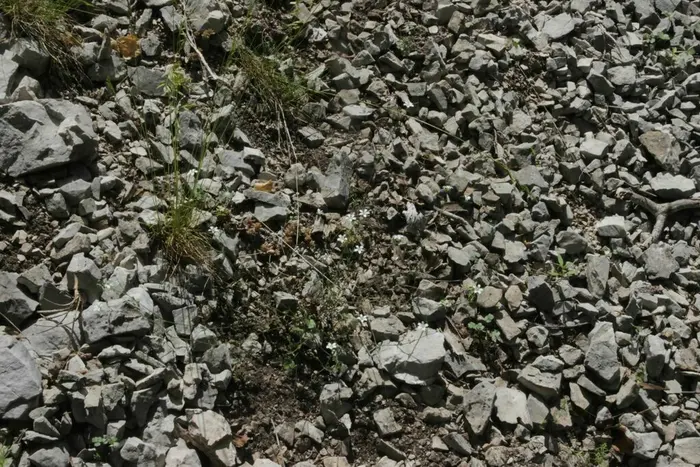
A small white-flowered plant, endemic to Provence, with a tiny range around the Verdon and the hinterland of Grasse. Rare and regionally protected.
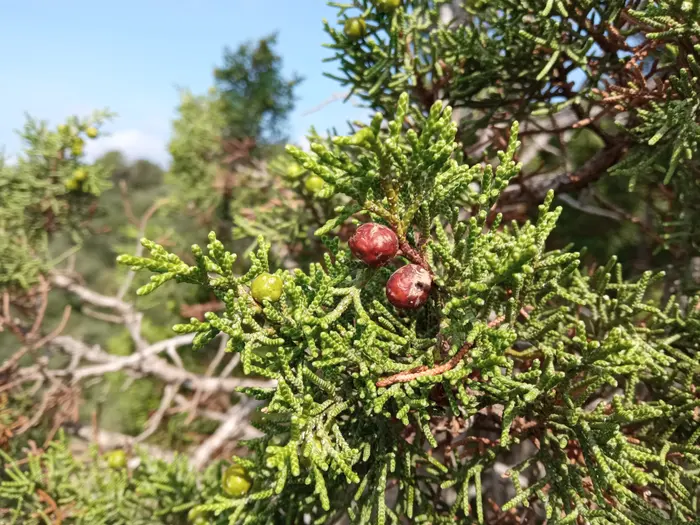
Clinging to the vertical cliffs, it grows so slowly that some individuals are several centuries old: near the Imbut, one of them has been dated at more than a thousand years old.
If only one plant could be remembered, it would be this one. The Verdon spleenwort (Asplenium jahandiezii) is a small fern a few centimetres long that grows nowhere else on the planet except in the gorges of the Verdon. Discovered in 1911, it clings to shady spots, in the cracks and beneath the overhangs of the limestone cliffs. A strict endemic, protected at national level and classed as near-threatened, it is the living symbol of what makes the canyon irreplaceable — and one more reason to respect its cliffs.
The cliff face is not a mineral desert: it is a vertical garden. Alongside the Verdon spleenwort live Bertoloni’s columbine, the blue flower of the cool scree, and the grey sandwort, a Provence endemic with a tiny range. The Phoenician juniper also clings there, a shrub so slow-growing that some specimens are several centuries old, even a thousand years old: near the Imbut, one of them has been dated at more than a thousand years old. On the ridges and limestone grassland grow the genêt de Villars and the rare raiponce de Villars. All these species are fragile treasures, adapted to an extreme environment.
Descending from the cliff, the vegetation is organised by altitude and aspect. The floor and slopes of the middle Verdon are covered with downy oak woodland (the white oak) mixed with Scots pine. On the warm, sun-facing slopes, at low altitude, grows the holm oak (the ilex), the Mediterranean tree par excellence; conversely, on the cool, shaded slopes and at altitude, beech woods appear. Everywhere, box, junipers and broom form the undergrowth.
Lower down and drier still stretches the garrigue — thyme, rosemary, wild lavender — while the dry limestone grassland, rich in flowers, is the domain of wild orchids. At the gateway to the Verdon, finally, the great lavender fields of the Valensole plateau make up the most famous cultivated landscape in Provence.
This exceptional flora lies at the heart of several Natura 2000 sites — the Grand Canyon and the Basses Gorges — whose limestone cliffs and dry grassland are habitats of European interest. The Verdon spleenwort and Bertoloni’s columbine are among the species that justified this designation. The main danger to the cliff plants is a paradoxical one: opening new climbing routes can destroy their micro-habitats — the cliff face is alive. Elsewhere, the ubiquitous box is suffering from the box tree moth, an invasive moth from Asia.
Several plants of the Verdon are protected and picking them is prohibited. In a regional nature park and on Natura 2000 sites, nothing is uprooted or picked — especially on the cliffs, home to unique species. Climbers, please respect sensitive sectors and the protection orders. Look, photograph: let the flower reseed itself.
Because the Verdon lies at the meeting point of two worlds: the Mediterranean influence, warm and dry, and the alpine influence, cooler and mountainous. This crossroads, combined with the diversity of habitats (cliffs, scree, forests, dry grassland, riverbanks), allows some 2,200 plant species to coexist — around a third of all the flora of France, on less than 2,000 km².
It is a small fern, Asplenium jahandiezii, strictly endemic to the gorges of the Verdon: it grows nowhere else in the world. A few centimetres long, it clings to shady spots in the cracks and overhangs of the limestone cliffs. Discovered in 1911, it is protected at national level and considered near-threatened.
No, it is best to refrain: several plants of the Verdon are protected (the Verdon spleenwort, Bertoloni’s columbine, the grey sandwort…) and picking them is prohibited. In general, in a regional nature park and on Natura 2000 sites, nothing is uprooted or picked: a flower left in place benefits everyone and reseeds itself.
Yes, but it is mostly cultivated: the great fields of lavender and lavandin on the Valensole plateau, at the gateway to the Verdon, form an iconic agricultural landscape. In the wild, the garrigue also offers thyme, rosemary and wild lavender on the dry slopes.
The rock faces are a habitat apart, colonised by specialist plants clinging to the rock: the Verdon spleenwort (an endemic fern), the Phoenician juniper (some individuals of which are a thousand years old), and various rock-dwelling lime-loving species. It is one of the most precious — and most fragile — habitats in the Verdon.
The external sources this page relies on, one click away.We would rather you be able to contradict us than ask you to take our word for it.
National reference system for species and protected areas: distribution, protection and conservation status of fauna and flora.
The area’s managing authority: regulations by environment (land, aquatic, vertical), bivouacking and camping, fire, drones, advice from the Park rangers.
2 of these 2 links responded during our last automated check, on 2026-10-02. A broken link is removed, never left in place.