History · Castellane
History of Castellane
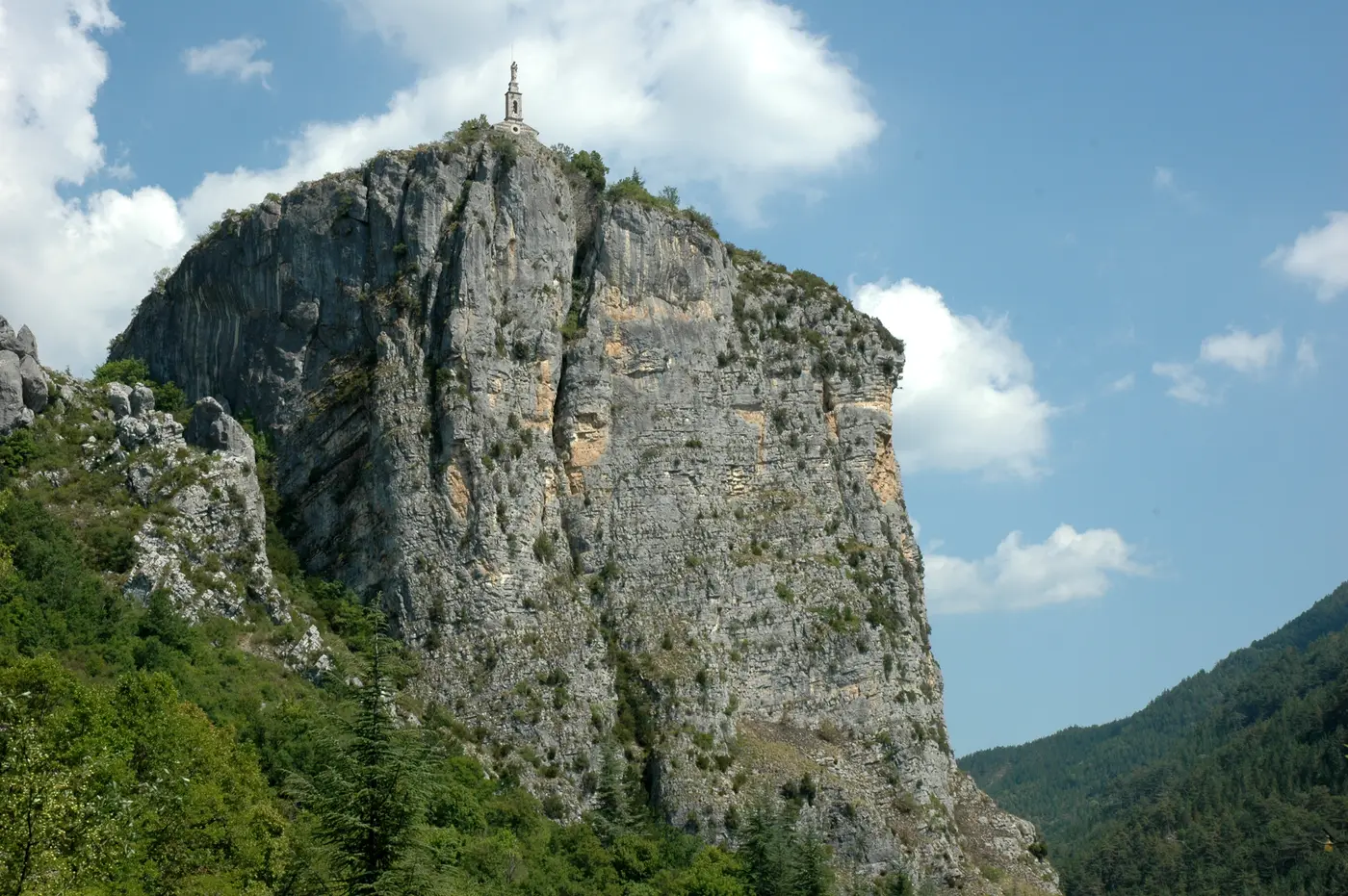
From the Ligurian oppidum of Ducelia to the liberation of 1944, by way of a 5th-century bishopric and a siege of 1586 still commemorated every year: Castellane has lived through two thousand years of history with the Roc, its limestone peak, as a common thread. Here are the main stages, sourced and verified.
Antiquity: from Ducelia to Salinae
Before the Roman conquest, the site was a Ligurian oppidum of the Suetrii people, known as Ducelia. In 14 BC, the Roman conquest made it the Civitas Saliniensum, then Salinae — a name probably linked to a salt-water spring exploited on the spot.
Less well known: Castellane was an episcopal see. In 439, Bishop Claudius, bishop of the Saliniens, sat at the Council of Riez — the earliest proof of a bishopric at Castellane. It was merged into that of Senez in the 6th century, bringing this episode to an end.
- before 14 BC
The site is a Ligurian oppidum of the Suetrii people, known as Ducelia.
- 14 BC
Roman conquest: the town becomes the Civitas Saliniensum, then Salinae — a name linked to a salt-water spring exploited on the spot.
- 439
Claudius, bishop of the Saliniens, sits at the Council of Riez: the bishopric of Castellane is attested from the 5th century.
- 6th century
The bishopric is merged into that of Senez; Castellane ceases to be an episcopal see.
The Middle Ages: the perched town of the Roc
In the Middle Ages, the town took refuge on the heights: Petra Castellana, attested from 965 (as Sinaca from 813), with a castle built in 977 by Pons-Arbaud and Aldebert. This fortified village was to be razed in 1483 on the orders of Louis XI and definitively abandoned in the mid-15th century, in favour of the plain where the present town stands.
The detail of this period — the three successive burgs, the siege of 1390, the ramparts of 1359 and their fourteen towers — is told in our sheet on the Notre-Dame-du-Roc trail, which today crosses the archaeological site of Petra Castellana.
The siege of 1586 and the Pétardiers
In 1586, in the midst of the Wars of Religion, a Huguenot attack led by the baron d’Allemagne and the Duke of Lesdiguières was repelled by the inhabitants — according to local tradition, Judith Andrau killed the besieging captain with boiling pitch. This episode is commemorated every year in late January by the Fête du Pétardier, a historical re-enactment in costume, one of the town’s oldest traditions — the details and the next dates are on our events calendar.
The Second World War and the Resistance
In June 1944, the local Resistance attacked German convoys in the area — reprisals followed: on 11 June 1944, eleven resistance fighters were shot by the Nice Gestapo at Saint-Julien-du-Verdon, a few kilometres from Castellane.
After the Provence landings of 15 August 1944, the town was liberated on 18 August 1944 by the US 3rd Infantry Division, as it moved up the Route Napoléon — the same road that Napoleon had taken in the opposite direction in 1815, stopping for lunch at the sub-prefecture of Castellane on 3 March.
- 6-9 June 1944
The Resistance attacks German convoys in the area; Saint-André-les-Alpes is taken by the 5th FTP company and the Secret Army.
- 11 June 1944
Eleven resistance fighters are shot by the Nice Gestapo at Saint-Julien-du-Verdon, a few kilometres from Castellane.
- 15 August 1944
Provence landings.
- 18 August 1944
Castellane is liberated by the US 3rd Infantry Division (the 3e DIUS in French sources), which is heading up the Route Napoléon.
- 23 July 1945
Inauguration of the memorial along road 202, restructured in 1996 (eleven granite tables forming a Cross of Lorraine); annual ceremony on 11 June.
The Museum of the Resistance in Castellane has re-enactments of the life of the local maquis. Find it on our page on the Verdon’s museums.
Frequently asked questions
Was Castellane ever a bishopric?
Yes, briefly. Under its ancient name of Salinae, the town was the seat of a bishopric attested from 439 (Bishop Claudius sat at the Council of Riez that year). The bishopric was merged into that of Senez in the 6th century.
What does the ancient name Salinae mean?
Before the Roman conquest of 14 BC, the Ligurian site of the Suetrii was called Ducelia. Having become a Roman town (Civitas Saliniensum), it took the name Salinae — probably linked to a salt-water spring exploited locally.
Was Castellane occupied during the Second World War?
Yes. The local Resistance attacked German convoys in June 1944; eleven resistance fighters were shot by the Gestapo at Saint-Julien-du-Verdon on 11 June 1944. Castellane was liberated on 18 August 1944 by the US 3rd Infantry Division, as it moved up the Route Napoléon after the Provence landings of 15 August.
Where can you learn more about this period in Castellane?
The Museum of the Resistance in Castellane has re-enactments of life in the maquis. A memorial along road 202 has honoured the victims since 1945.
What remains of the medieval fortified village of the Roc?
The perched town of Petra Castellana (attested from 965, castle built in 977) was razed on the orders of Louis XI in 1483 and abandoned in the mid-15th century in favour of the plain. The details of its history — the siege of 1390, the ramparts, the Pentagonal Tower — are in our sheet on the trail that leads there today, the Notre-Dame-du-Roc trail.