Moustiers-Sainte-Marie · 04
Musée de la Faïence de Moustiers
Awarded the “Musée de France” label, the museum traces three centuries of Moustiers faience across nine rooms — from the first blue camaïeu of 1679 to contemporary creations.
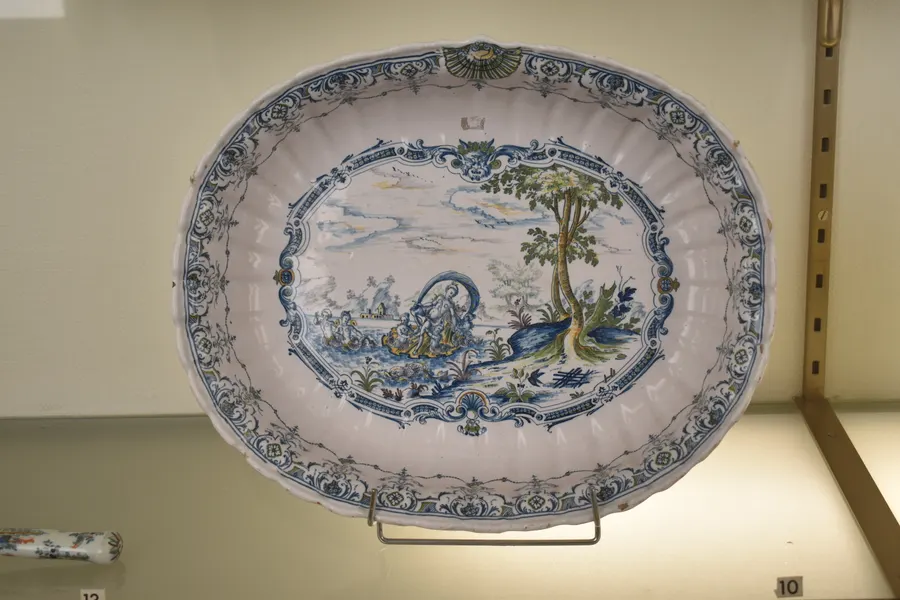
- Founded by Marcel Provence and the Académie de Moustiers, the museum opened on 15 September 1929; it holds the “Musée de France” label.
- After major renovation and extension work, it reopened on 27 June 2014, with nine rooms spanning nearly 300 m².
- It holds a rich collection (nearly 1,300 works according to the museum), several hundred of which are on permanent display.
- More than half of the faience on display comes from the donation of collector Pierre Jourdan-Barry.
- Its mission: to show why the village was an ideal place for faience, and to make clear the evolution of decoration, shapes and colours from its origins to today.
What you'll see
- A tour through nine rooms, arranged both thematically and chronologically, ending in a room for temporary exhibitions.
- Spaces devoted to the great decorative styles: the blue room (cobalt-blue camaïeu, monochrome), the connoisseur's cabinet, the garland-decor room, the grotesques room, and the “rose” room of the 18th-19th centuries.
- Large ceremonial chargers (50 to 60 cm) decorated with hunting scenes after engravings by Antonio Tempesta, characteristic of the first blue period.
- Works by contemporary faience-makers, showing that the tradition continues in Moustiers today.
Three centuries of faience
- Ceramic production dates back to the Middle Ages, but faience proper began in the 17th century: Pierre Clérissy was recorded as a master faience-maker in 1679 — the grand feu (high-fire) era of cobalt-blue camaïeu (monochrome) decoration, often featuring hunting scenes.
- Around 1710, “Bérain-style decoration” emerged — arabesques and grotesques inspired by Jean Bérain, ornamental designer to Louis XIV.
- Around 1737-1738, back from Spain, Joseph Olerys introduced polychrome decoration and grotesque motifs; the Olerys-Laugier partnership was founded in 1739 (garlands, medallions).
- Other manufactories built the village's reputation during the 18th century — Fouque, Féraud (1779), Ferrat (around 1763) — introducing “petit feu” (low-fire) ware with brighter colours; at its peak, there were up to twelve factories.
- Decline began as early as 1769 (the discovery of kaolin near Limoges, the rise of porcelain), then continued with the arrival of English fine earthenware with printed decoration; the last workshop closed in 1874, followed by around fifty years without any production.
Revival and the founding of the museum
- In the late 1920s, the man of letters Marcel Provence (Marcel Joannon) revived Moustiers faience by relighting a kiln.
- He founded the Académie de Moustiers, dedicated to studying and promoting local faience and folklore, then the museum, which opened on 15 September 1929.
- Today the museum occupies premises in the heart of the historic village, linked to the former townhouse of the lord Bertet de la Clue.
Why Moustiers
- Clay-rich soil and an abundance of wood to fuel the kilns attracted potters as early as the early Middle Ages.
- Under Louis XIV, sumptuary edicts that led to precious-metal tableware being melted down encouraged a fashion for faience tableware among the European aristocracy.
- Moustiers, awarded the “Ville et Métiers d'Art” label and ranked among “Les Plus Beaux Villages de France”, has made faience its defining heritage — beneath the famous star suspended between two cliffs, at the foot of the Notre-Dame-de-Beauvoir chapel.
The museum is located in the heart of the historic village of Moustiers-Sainte-Marie (04360), on rue du Seigneur Bertet de la Clue, near the church and the town hall, at the foot of the valley leading up to the Notre-Dame-de-Beauvoir chapel. The tour covers nine rooms across nearly 300 m²; allow around an hour for the visit.
Official museum website (opening hours & prices) ↗Frequently asked questions
When was the museum created?
It opened on 15 September 1929, at the initiative of Marcel Provence and the Académie de Moustiers. Renovated and extended, it reopened on 27 June 2014.
What will you discover during the visit?
The evolution of Moustiers faience from its origins to today: the blue camaïeu of the Clérissy family (from 1679), Bérain-style decoration, and the polychrome grotesques of the Olerys family, right up to contemporary creation.
Is the museum the same thing as the village workshops?
No. The museum (which holds the “Musée de France” label) is a heritage site presenting the collections; it is separate from the working faience workshops and shops in the village, which keep the craft alive but are commercial businesses.
Why did faience originate in Moustiers?
The village had all the resources it needed — clay-rich soil and abundant wood for the kilns — and, around the turn of the 18th century, benefited from the fashion for faience tableware among the aristocracy.
Check for yourself
The sources this page relies on, one click away. We would rather you be able to contradict us than ask you to take our word for it.
- Musée de la Faïence — site officielmusee-moustiers.fr
- Wikipédia — Musée de la faïence de Moustiers-Sainte-Mariefr.wikipedia.org
- Wikipédia — Faïence de Moustiersfr.wikipedia.org
- Office de tourisme de Moustiers — histoire de la faïencemoustiers.fr
All 4 links responded during our last automated check, on 22 September 2026. A broken link is removed, never left in place.